Wednesday, May 16, 2018

1943 Ontario Provincial Election Scrapbook

Before reading this article, check out my article for TVO about the 1943 Ontario provincial election.

Globe and Mail, July 19, 1943.

I'm beginning to think that editorial cartoons showing a paper's preferred candidate sowing a field was an easy sketch for cartoonists to do in the midst of a campaign.

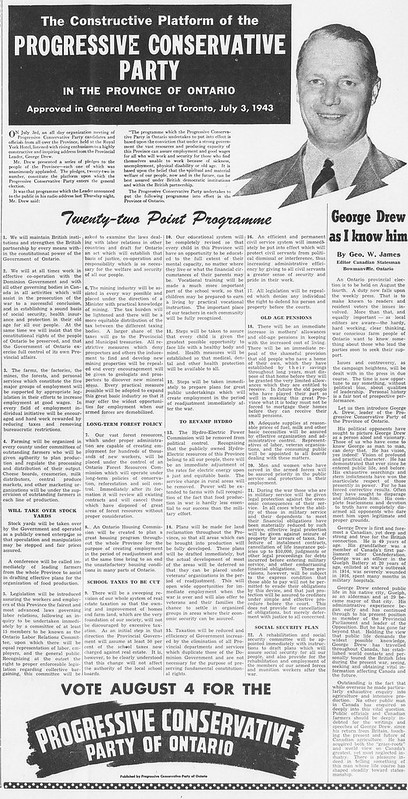
canadian statesman 1943-07-15 pc ad with 22-point programme
Canadian Statesman, July 15, 1943. Click on image for larger version.

A campaign ad with the Progressive Conservatives' full Twenty-Two Point Programme.

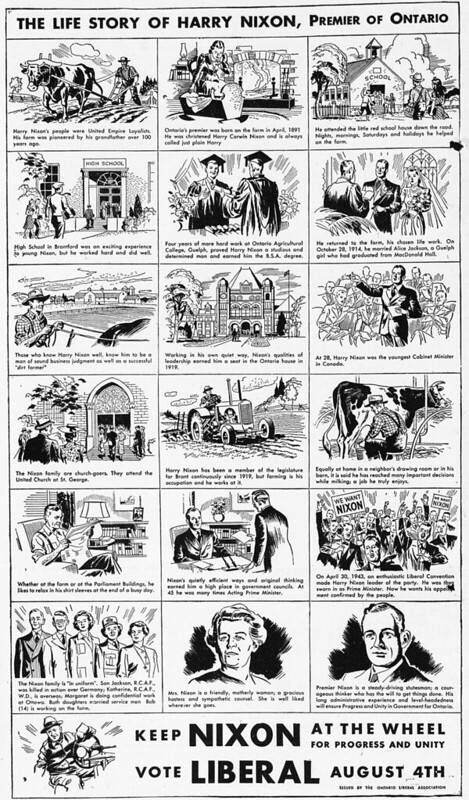
canadian statesman 1943-07-29 life story of harry nixon ad
Canadian Statesman, July 29, 1943. Click on image for larger version.
The Liberals took a graphic approach to highlighting the accomplishments of Harry Nixon.

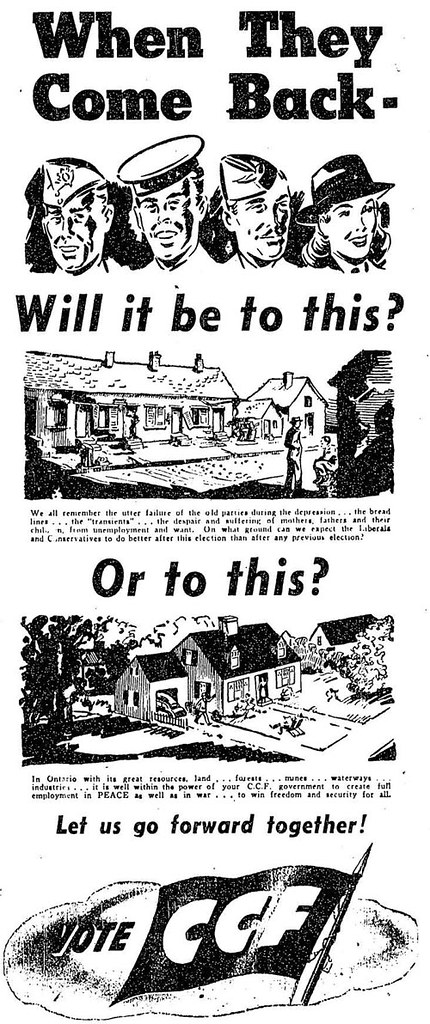
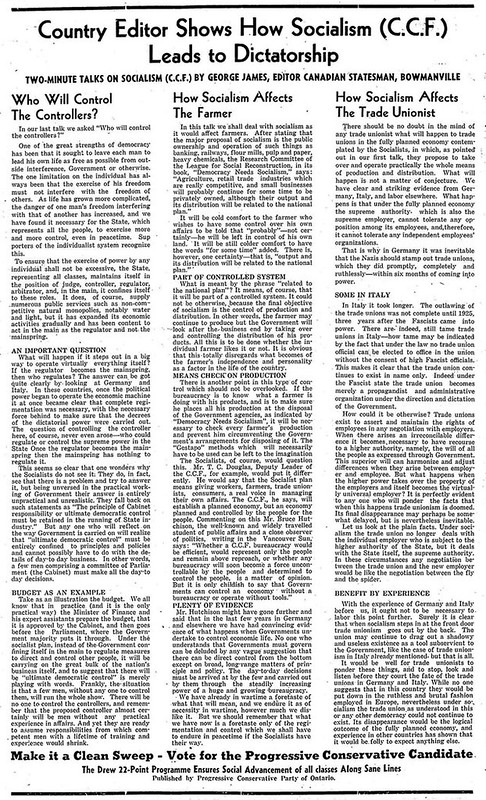
gm 43-08-02 ccf ad
Globe and Mail, August 2, 1943.

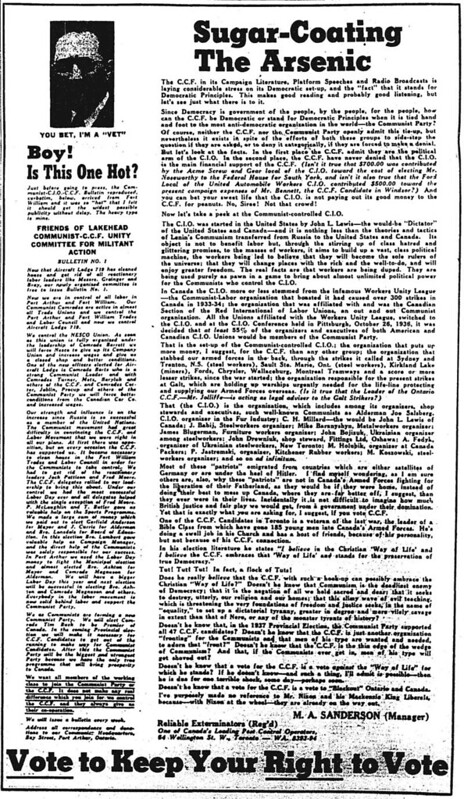
gm 1943-07-29 sanderson anti-ccf ad
Globe and Mail, July 29, 1943. Click on image for larger version.
Political propagandist Montague Sanderson felt there were more pests to exterminate than the insect kind. During the 1943 campaign, he bought four ads in the Globe and Mail which touted his credentials as a First World War vet and desire to destroy the CCF. Sanderson's lawyer once described his motives as “partly patriotic, partly for the glory and publicity, and partly the advertising obtained for his business.” He believed the party was paving the way for a “Communists-CIO-CCF dictatorship” which “would exterminate democratic government by violence.”

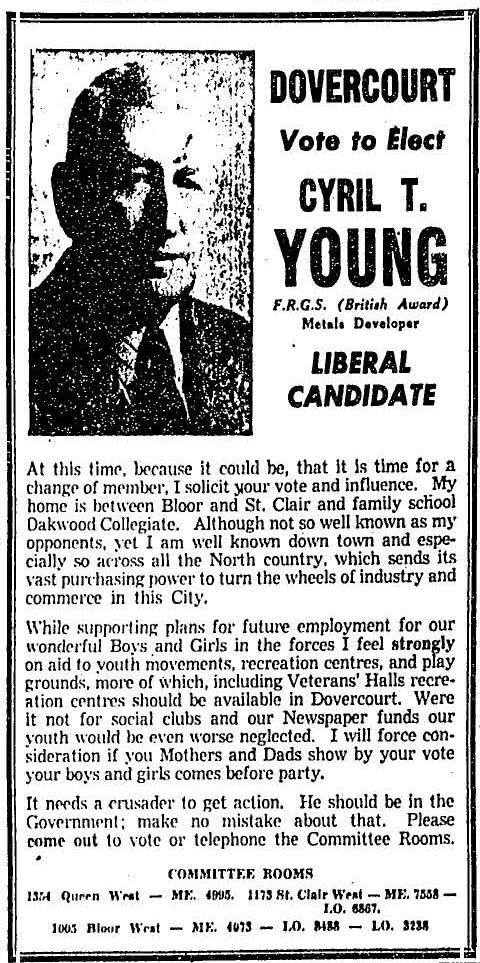
gm 43-08-02 cyril young ad
Globe and Mail, August 2, 1943.
An important lesson to political candidates: hire a proofreader to make sense of your platform. This ad didn't work for Cyril Young, who finished a distant third.

Leamington Post, July 15, 1943.
Election ads during wartime. William (Bill) Murdoch had a long political career, serving as MPP for Essex South from 1943 to 1963, then served as a councillor in Amherstburg. He also served as Speaker in the legislature from 1960 to 1963.


Stouffville Tribune, July 29, 1943.

stouffville tribune 1943-07-29 anti-ccf conservative ad
Stouffville Tribune, July 29, 1943. Click on image for larger version.

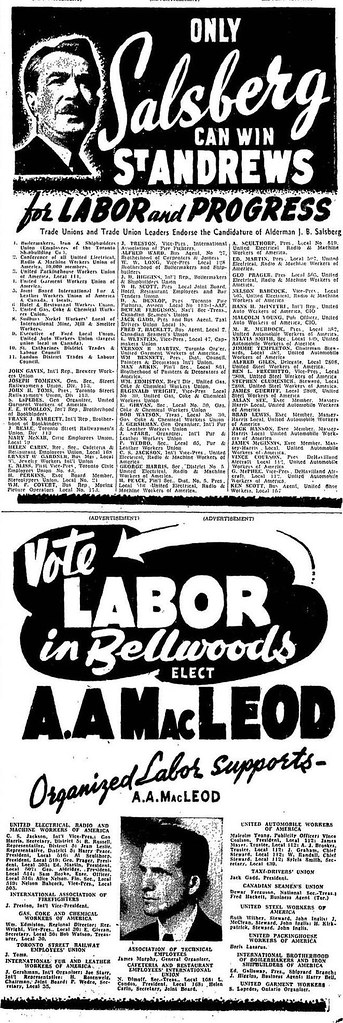
ts 43-08-03 commie ads
Toronto Star, August 3, 1943. Click on image for larger version.
Salsberg's victory was celebrated with a parade which began at College and Brunswick, grew to around 1,000 people, and wound its way to Spadina and Dundas. “It was late at night,” Salsberg later recalled. “it was warm, people were sitting outside. They not only applauded…when they saw me leading the parade, they rushed and we hugged and kissed—strangers. It was a communal affair.”


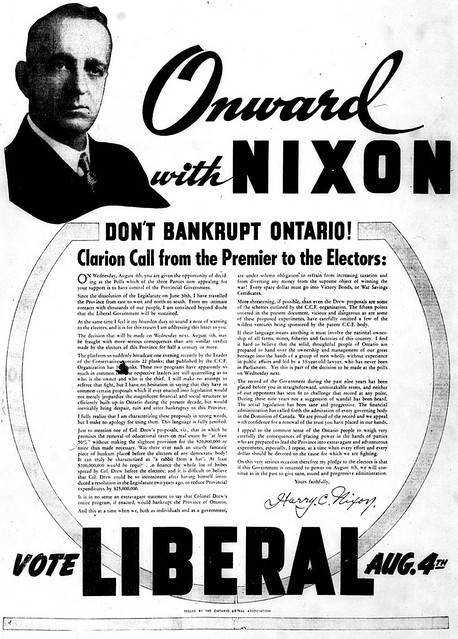
tely 43-07-31 nixon ad
Evening Telegram, July 31, 1943. Click on image for larger version.

Evening Telegram, July 30, 1943.

George McCullagh's political affiliation firmly switched to the Progressive Conservative camp by the time of the 1943 election, having lost his political influence over former Liberal premier Mitch Hepburn. Editorials in the Globe and Mail touted the campaign as one of the most important in Canadian history, and I imagine McCullagh's radio address was similar to his paper's excitement for Drew's platform.

Allan Lamport had been an MPP since 1937, but fell to third in 1943. The two candidates who beat him did pretty well for themselves. Winner William Dennison (CCF) would, like Lampy, eventually serve as mayor of Toronto. As for the second place finisher in St. David...

Evening Telegram, August 3, 1943. Click on image for larger version.
...Roland Michener would win the seat in 1945, and later served as Governor-General of Canada from 1967 to 1974.

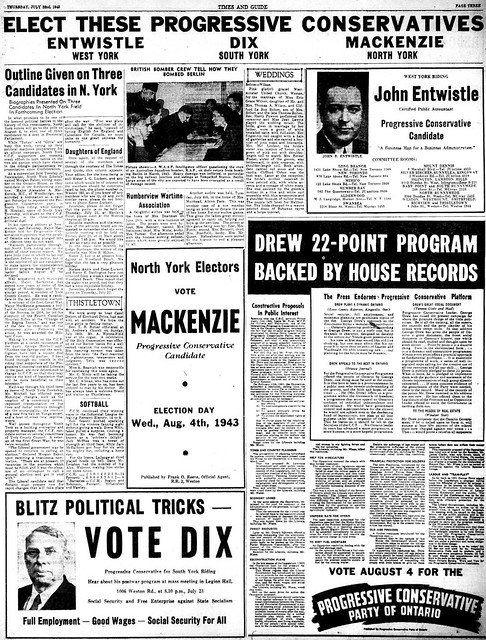
wtg 43-07-22 tory ads
Weston Times and Guide, July 22, 1943. Click on image for larger version.
None of these PC candidates won, as the CCF swept all three of these ridings. So much for blitzing political tricks.

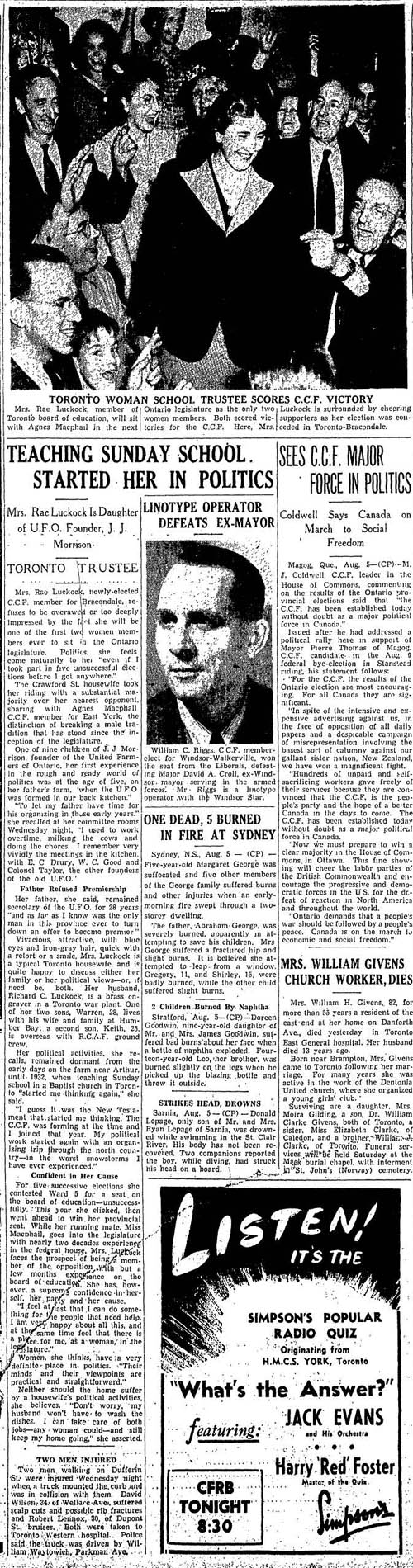
ts 43-08-05 luckock victory
Toronto Star, August 5, 1943.
Coverage of Rae Luckock's victory.

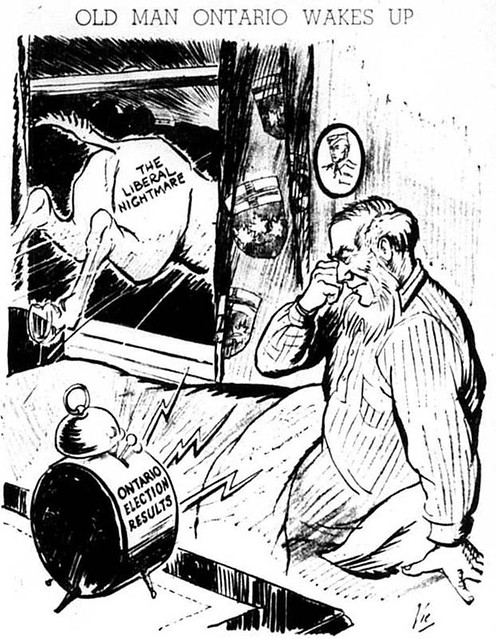
tely 43-08-05 editorial
Evening Telegram, August 5, 1943.

Old Man Ontario went back to sleep, and didn't wake up again until 1985 (apart from that period between 1949 and 1961 where he served as premier under the alias Leslie Frost).

Friday, May 11, 2018

1919 Ontario Provincial Election Scrapbook

Before reading this post, check out my article for TVO about the 1919 Ontario provincial election.

Border Cities Star, October 18, 1919.
A staple that has regularly popped up while researching Ontario elections is the editorial cartoon depicting a farmer, either representing the province or a party leader, tending their field of candidates.

Border Cities Star, October 18, 1919.
Who cares how strong a candidate's platform is when there's going to be a good band at the political rally! The high caliber of musicianship didn't help "Bill" Woollatt, a Conservative who lost the riding of Windsor to Liberal J.C. Tolmie by over 4,600 votes, a margin the Border Cities Star claimed was the largest in the riding's history.

Essex Free Press, October 17, 1919.
Another age-old tactic: claim your competitors are incompetent or deceptive in their aims. Alas, this tactic didn't work for Lambert P. Wigle in South Essex...

Border Cities Star, October 18, 1919.

...but this list of promises from UFO candidate Milton C. Fox did. Number four definitely happened, as Talbot Road became Highway 3.

Evening Telegram, October 9, 1919.
London Free Press, October 17, 1919.

One of the more amusing battles between the wets and the drys, involving another vice.


The Globe, October 18, 1919.
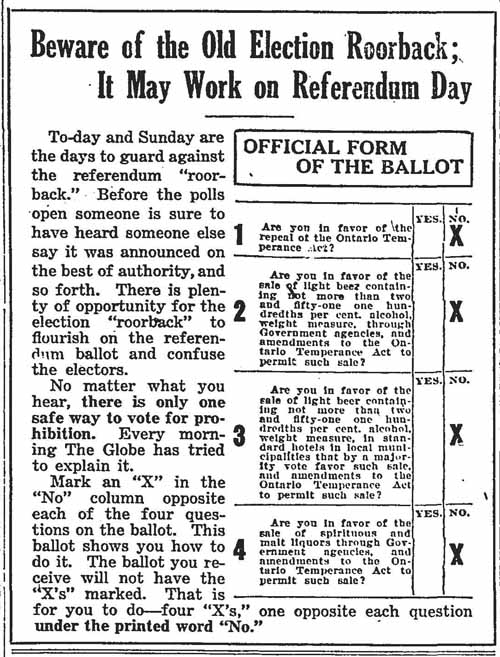
Newspapers had no shame in not only telling its readers how to vote, but showing via illustrated diagrams how to fill out their ballots.

The Globe, October 20, 1919.
These pleas often made their way to the front page, such as this election day reminder.

The Globe, October 20, 1919.
As it was the first provincial election where women voted, the women's page was not immune to gentle persuasion on how to cast ballots.

The Globe, October 21, 1919.

Toronto election coverage taken from the Globe's women's page.

Toronto Star, October 18, 1919.
How a meeting for Henrietta Bundy, one of two female candidates in the election, was covered.

Border Cities Star, October 18, 1919.

Border Cities Star, October 18, 1919.

Border Cities Star, October 18, 1919.

Border Cities Star, October 18, 1919.
Toronto Star, September 17, 1919. Click on image for larger version.

Sudbury Star, October 11, 1919.
A sampling of the ad battles between the wet and dry sides.

London Free Press, October 20, 1919.
Advertisers couldn't resist taking advantage of election fever. I think the girl third from the left is sour because she voted for Wrigley's Doublemint gum.

Thursday, March 15, 2018

I Am an Elite


My name is Jamie, and I am an elite.

In the present context of how the term is used by populists in a derogatory fashion, I proudly claim use of it to describe myself.

What are some of the attributes I claim as an elite in the current political climate?


  • An elite is a person who cares about their community, and the welfare of those within it.
  • An elite is a person who knows the intrinsic value of things, rather than knowing the cost of everything and the value of nothing.
  • An elite is a person who has striven to be educated by whatever means works for them (on their own and/or via institutions), and remains open to learning more.
  • An elite is a person who strives to improve conditions in society, without resorting to (as much as possible) appeals to baser emotions, to prejudices, to age-old distrusts and hatreds.
  • An elite tries to be constructive, not divisive.
  • An elite listens instead of talking over others.
  • An elite looks at the lessons from the past, contemplates them, and figures out to best apply them to current conditions.
  • An elite values truth above convenient, cynical lies.

Are these elites perfect? Hell no. We all screw up and will inevitably alienate others. You can’t please all of the people all of the time. Improvements, especially controversial ones, take time and effort to win over majorities to see the value in them. Right now, we’re doing a lousy job of it, allowing populists to hold sway over sections of the public who feel defeated, mocked, worthless, or, at worst, don’t give a damn about anybody else.

***

These thoughts flowed through my head while out for an evening walk on a day where I emotionally bottomed out. It’s been a tough winter mentally for various reasons, and I’ve exacerbated it with a daily diet of informational radio. My final breaking point occurred while sitting in my car, listening to a recap of an interview CBC did with the new leader of the Ontario Progressive Conservative party, which he spent trying to turn the tables on the interviewer instead of providing anything remotely resembling a straight answer.

I turned the radio off before the clip was over. My heart sunk. This was a man who has a strong chance of becoming the next premier of Ontario behaving like a total jackass. Behaviour that a swath of the population embraces, or will tolerate because they can’t stand the current government.

Those who know me well will tell you I’m an emotional sponge who soaks up sensitivity. At that moment, I felt the cumulative effect of a growing feeling inside that the type of person I’ve always striven to be is currently not valued by society, or at least the loudest segments of it. My brain had one question on repeat: does it pay to be a respectful person anymore? What is the point of trying to educate others about the past, to listen to other viewpoints, to seek truths, to make a better place for all, if nobody will listen or others will mock you for your thoughts and efforts?

Why should I give a damn if nobody else wants to, or if other humans are too interested in preserving their own interests with the potential to harm others?

I see this play out daily. We yell at each other in public and online. We try to get ahead by a few seconds on city streets, with potentially fatal consequences. We see politicians do everything but make serious attempts to fix problems. We complain, complain, and complain some more, without offering constructive criticism or praise where merited. We stick to our partisan silos. We increasingly see black and white, instead of shades. The art of nuance feels like its vanishing.

I picked up my wife after the walk. I decided we would go for a drive to unwind. As we drove, rather than accept her help, I stewed in my misery, feeling like I was taking on the weight of humanity when I didn’t need to. The forces of misery held the upper hand.

But, to her credit, she continued to try even if I wasn’t up to playing along at the moment. She noted too much info about the current American administration and Canadian populists was too much for anyone to have a reasonable psychological handle on. That there are people doing good things out there, from assisting refugees to small acts of kindness. These are not the sexy stories, but they are the ones that matter more than somebody’s latest outrageous statement. She repeatedly asked me to name something I was grateful for (I finally responded that it was sitting next to me).

So, besides embracing the derogatory label of “elite,” I’m going to make a few changes. While not withdrawing from social media, I am paring down my feeds to reduce the number of references to certain political figures. I am taking a break from listening to NPR and CBC, and looking for more creative, enlightening shows and podcasts to listen to (feel free to leave suggestions in the comments).

I’m not checking out of life, but re-embracing it, and hoping that this spring provides many opportunities to re-engage with friends, my personal work, and my community, without most of the bullshit currently in the ether. I want to feel less despair about my world, or at least accept less despair than some forms of media push. I will continue to provide in my professional work context that hopefully means something to somebody.

The populists may have an upper hand at the moment, and they just about did me in. But, in small ways, I’m going to fight against their intolerance and instability and work on being the best contemplative/respectful person I can be. 

There is no shame in using one's intelligence.

There is no shame in using one's compassion and empathy.

Elitist or not.

Tuesday, February 13, 2018

Pressing Questions of the Moment Department: Toilet Paper Roll Size


Nearly all packages of toilet paper proudly proclaim that they contain "double" or "triple" rolls. Yet I don't know if I have ever seen a "single" or "regular" sized roll.

Are they referring to a size nobody has seen since I was born? Is "regular" the one-ply, sandpapery stuff preferred by budget-conscious public toilets? Or are manufacturers inventing value that doesn't exist?


Apparently "regular" size rolls exist in the United States, and they sound skimpy. This coming from a country where you can buy single rolls at the supermarket, which may reflect customers who are occasional toilet paper users, on tight budgets, prefer it over Kleenex for general tissue needs, or require an emergency roll for their backpack/car/visit to a public place.

All I know is that regardless of the alleged sizing, most rolls disappear in a hurry.

Friday, February 9, 2018

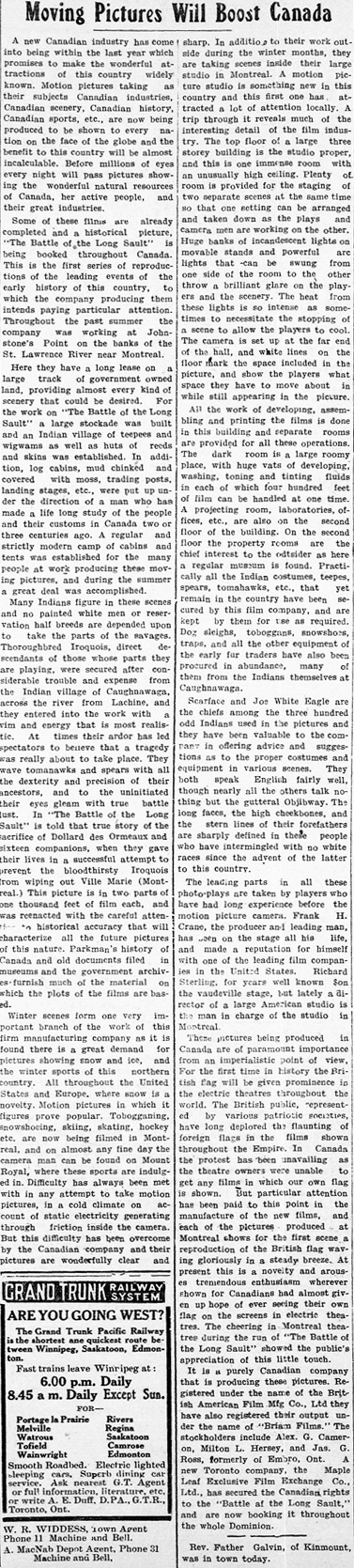
Motion Pictures Will Boost Canada (and a peek at Moving Picture World)


lp 1913-02-14 motion pictures will boost canada
Lindsay Post, February 14, 1913.
A look at the early days of the Canadian film industry. The Battle of the Long Sault (1913) has an IMDB entry, though the only information it provides is a capsule description from Moving Picture World magazine.

Since the Internet Archive has posted back issues of Moving Picture World, let's take a look at what other movies were discussed in its April 26, 1913 edition.


The most historically important film listed was The Bangville Police, which was one of the first appearances of the Keystone Kops. "More laughable absurdities, in which Fred Mace appears as police captain in a home-made automobile. As a whole, this reel is very pleasing and full of laughs."

Which is a longer description than what was printed about Edison's The Rocky Mountains in Winter:  "Some good views of snowy hills and valleys." One can hear the copy writer straining for something nice to say. Not that MPW wasn't capable of being critical--the short comment about Pathe's The Happy Home calls it "A picture with an unusually poor scenario. The director couldn't save it."


An ad for upcoming films from Universal. Only a drama spotlighting one of the leaders of the Reign of Terror during the French Revolution earns an adjective. At the time, Universal would have celebrated the first anniversary of its incorporation.

Wednesday, February 7, 2018

Public Transit Department: " A Small-Sized Riot Nipped in the Bud"

Toronto Star, October 25, 1918.

I wonder how much this situation may have been exacerbated by the Toronto Railway Company's overall poor public PR image. Other newspaper stories around this time hinted at the eventual public ownership of all of the city's streetcar lines after the TRC's franchise expired in 1921. 

Speaking of public transit overcrowding, check out John Lorinc's Spacing piece on the possibility that years of not properly managing the subway system's passenger capacity will have fatal consequences.

Monday, February 5, 2018

Scary Pitchmen Department

Rummaging through old newspapers, I frequently encounter startling illustrations in ads that make you wonder if the advertiser was trying to draw customers or scare the bejeezus out of readers.

Here are some recent finds.

Toronto Daily News, November 17, 1917.

This fellow topped an ad for a downtown Toronto furniture store. The pinprick eyes and dark shadows surrounding them suggest something alien or robotic. Is a trace of an evil smirk detectable? Or is he hypnotizing the reader into buying beds and victory bonds?

When he talks, it's in a slow, mechanical, increasingly menacing way.

"How may I help you? Interested in that chair? It's not within your financial limitations. What you should buy is a bond. A Victory Bond. A bond to help the war effort. Our war effort. BUY THAT BOND TO-DAY. It's good bih-zi-NESS! It's pay-tree-OT-ISM!!! We will win the WAR! CONQUER! ANNIHILATE!!!"

(At which point the store manager comes to unplug our creepy friend, apologize to the scared customers, and sell them more bonds).

Lindsay Watchman-Warder, February 17, 1910.

Cure-all patent medicines used illustrations of "customers" testifying to the miraculous powers of their product. Sometimes, you might accept the stuff worked. Not so sure in this case. Mrs. Minnett still doesn't look too happy (she had been in pain for 60 years, and was possibly suffered from phantom remnants of her long-term ailment), unless she simply hated the camera. Maybe it's the low-grade reproduction, but when Louisa and I looked at her picture, we decided she was the offspring of Jo-Jo the Dog-Faced Boy and Cloris Leachman as Frau Blucher from Young Frankenstein. Also, her hair was possibly sculpted from clay.

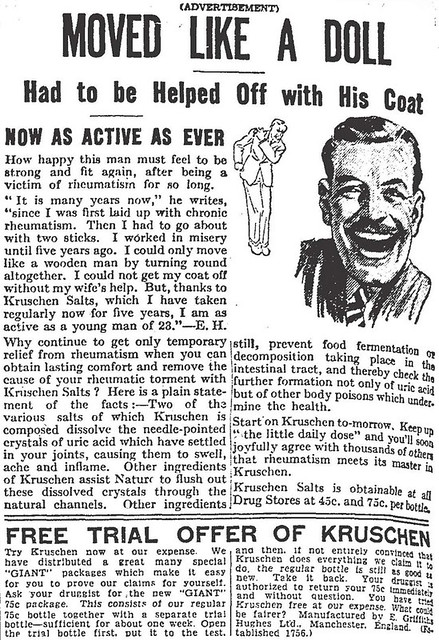
star 1933-02-09 scary moved like a doll ad
Toronto Star, February 9, 1933. 
This ad does not make a strong case for the effectiveness of Kruschen Salts. Before, our testifier moved like a wooden man. After, he looks like a wooden man, with an unnatural smile only a ventriloquist's dummy can flash.