Showing posts with label childhood. Show all posts

Friday, October 26, 2018

New Czar for the NHL

One of my most battered possessions is a copy of the 1977/78 Hockey News Yearbook. Its tattered cover bears all the signs of having used it to press down on while scribbling imaginary road maps, stamp catalogues, and sports leagues as a little kid (I was a little weird, but let my imagination run wild. Heck, I still draw imaginary maps as a stress reliever). I also read the magazine a lot, fascinated by hockey teams and leagues that vanished just before I started following the sport (Atlanta Flames! Cleveland Barons! Cincinnati Stingers! Houston Aeros!).

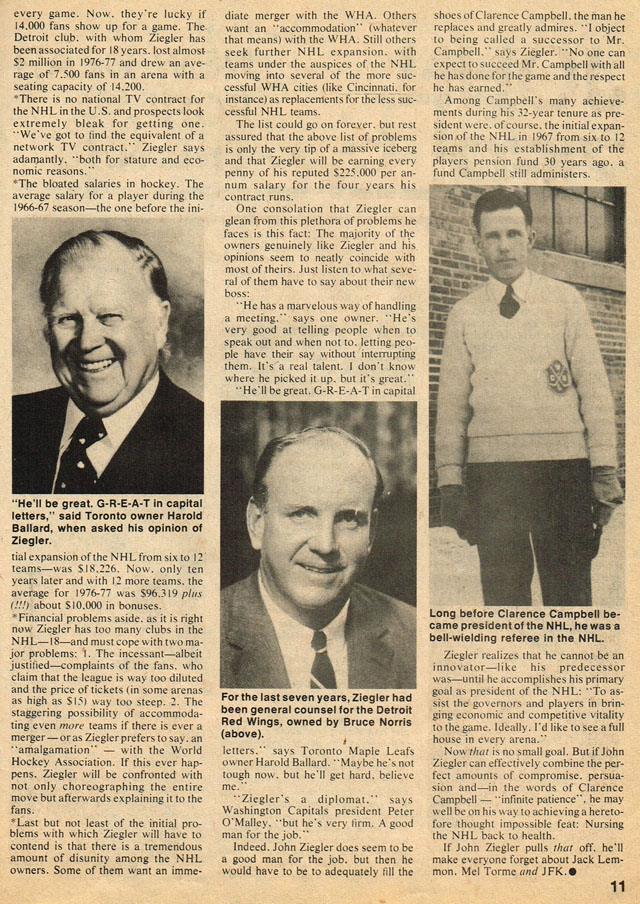
Upon hearing the death of former NHL president John Ziegler, I remembered this magazine had a two-page spread about his hiring, which came as the NHL/WHA war neared its end. A few things to note from this article:

* NHL franchise issues. The Atlanta Flames moved to Calgary in 1980. Ralston Purina hung on to the St. Louis Blues until 1983, when it nearly sold the franchise to a group prepared to move the team to Saskatoon. The league felt that market was too small, another buyer was found, and the team has remained in St. Louis. The Cleveland Barons (previously the California Golden Seals) merged with the Minnesota North Stars following the 1977/78 season.

* That $15 top seat price fans complained about? If that was charged at Canadian arenas it would be worth, according to the Bank of Canada's inflation calculator, $58.64. The most expensive available full price ticket at the next Maple Leafs game is, with taxes, $706.80. The cheapest ticket available is $160.75 (I imagine prices are inflated for a Saturday night game, but even next week, the cheapest tix are $90. This explains why I have attended only one NHL game in my life, and that ticket was won in a random office draw).

* Beware glowing praise from Harold Ballard. 

* The Detroit Red Wings were about to enjoy a brief break from the "Dead Things" era which lasted from the late 1960s until Mike Ilitch bought the team from Bruce Norris in the early 1980s. Under new coach Bobby Kromm, the 1977/78 Red Wings finished second in the Norris Division and made the playoffs for the first time since 1970. After their trip to the quarterfinals, losing to eventual Stanley Cup champion the Montreal Canadiens, they wouldn't reach the playoffs again until 1984.

* I don't remember where I saw the quote, but I recall an Original Six era owner or executive referring to how lucky the league was that they had a president as malleable as Clarence Campbell. The statement was along the lines of how often can an organization have a Rhodes Scholar figurehead who's so easy to control. 


Sunday, February 4, 2018

"Possibly the most daringly dramatic development in the field of contemporary literature"


While sifting through my possessions prior to moving in with Louisa a few years ago, I found a box of comics I thought I had gotten rid of. The contents were longstanding parts of my once massive collection that I probably held on to for sentimental value. Since these comics were half-forgotten, the sentimental pull wasn't that strong, so they quickly wound up in boxes designated for selling off.

Among the issues I found was one of the first 1960s Marvel Comics I owned: Fantastic Four #41, cover dated August 1965. I bought it in Ann Arbor at Dawn Treader Book Shop in the late 1980s, when it was located on the north side of Liberty Street. Dawn Trader was part of the first circuit Dad and I utilized when I began going downtown with him instead of following my mother and sister to Briarwood Mall: Afterwords, Borders (the flagship store, then on State Street), David’s Books, Dawn Treader, and Schoolkids’ Records. Only Dawn Trader survives of that quartet, notable for the amusing items lining its outdoor bargain racks. Its current space is far roomier than the one I bought FF #41, which contained the narrowest aisles I've ever encountered in a used book store. We are talking airplane or subway seat wide. Aisles narrow enough that a chunky pre-teen had to slip through sideways. One sensed the owner maximized their limited basement space to display as much as possible.

FF #41 sat in a box of $2 comics,  a small fortune compared to the pennies I spent building my collection at stores like City Lights in London. Most issues in this box were mid-1960s vintage, titles I was discovering through endless borrowings of histories of comic books from the Windsor Public Library and a serialized history Marvel published at the time, Marvel Saga. It dawned on me a few years later that they might have been slightly undercharging for early Marvel superhero titles like Strange Tales and Tales of Suspense, but by that time, the box was long gone.

From the box I picked out three comics: an issue of the first volume of the Official Handbook of the Marvel Universe (the second volume was being published at the time, which was nirvana for a nerdy budding historian dipping into the world of comics); Tales to Astonish #72 (a classic Marvel split-book: one half featured the Sub-Mariner in the midst of the long quest which launched his 1960s solo adventures, while the other starred the Hulk, temporarily sharing Bruce Banner’s brain, worrying about returning to human form lest a bullet in his head kills him upon transforming – drama!); and FF #41.

It may have been the age of the issue. Or that I was regularly reading Fantastic Four at the time, even if 1987-88 was not one of the series’ finest hours (this was the period where the Thing resembled a spiky pineapple). Or that it was an honest-to-God Stan Lee and Jack Kirby comic book.

Or it may have been the cover blurb: “Possibly the most daringly dramatic development in the field of contemporary literature.” Even at that age, I sensed Stan was pushing it, but in a charmingly hyperbolic way. This was a period where Marvel went full-tilt with long-running sagas in its titles, where storylines stretched for as long as two years without taking a breather, as opposed to wrapping up in an issue or two.

The story for FF#41 began five issues earlier, with the introduction of the Frightful Four, who was comprised of two villains from the Human Torch's solo series (the Wizard and the Trapster), a Spider-Man foe (Sandman), and a mysterious new character named Medusa. Over the next few issues, the Frightful Four caused an explosion which removed the FF's powers...just in time for Doctor Doom to snap out of a hypnotic suggestion Reed Richards had placed on him and decide to kill the team once and for all. With the aid of Daredevil, the FF regain their headquarters, then their powers. But for Ben Grimm, becoming the Thing again is not a happy moment, and he nearly kills Doom. Pissed off at being forced to be a freak again, the Thing quits the team.

Which leads us into FF #41. That daring development promised on the cover? Ben is brainwashed by the Frightful Four. As Supermegamonkey puts it, we know the Thing has gone bad "because he chain smokes his ceegars, even during fights." The fighting ensues for two more issues, during which the Human Torch pretends to be brainwashed (there are plenty of scrambled brains in this run of FF). This then leads into Reed and Sue's wedding, then a 17-issue sequence which introduces the Inhumans, Galactus, Silver Surfer, and the Black Panther.

Some thoughts on why this run of FF and a simultaneous stretch of Thor satisfied the growing number of Marvel readers, from Will Jacobs and Gerard Jones's book The Comic Book Heroes:

To the loyal Marvel fan, who had followed the plot developments from their inception, these two years of Thor and The Fantastic Four were like a wondrous tapestry of lost worlds, distant galaxies, and uncanny creatures; a trip to the newsstand or the drugstore each month became a new step in a voyage into uncharted realms that seemed to have no bounds.

These voyages continue to inspire today, as elements from these runs fill movie theatres.

My comic book collection grew steadily after picking up this issue, as I scoured bins for old comics that were rarely in pristine physical condition. At its peak in the early 2000s, it covered several rows of bookshelves in my Mom's basement. But then it was time to cull, down to its present state of a shelf of collected editions and graphic novels, and a tiny sampling of single issues. Selling off the rest kept me financially afloat during one of those dry periods freelancers encounter.  I don't regret that decision, since there are plenty of sources for whenever I feel like indulging in more daringly dramatic developments in 20th century graphic literature.